In molecular biology and biochemical research, the Colorimetric Activity Assay Kit remains a fundamental tool for measuring enzyme activity, substrate turnover, and reaction efficiency. These kits are designed to provide simple, sensitive, and reproducible detection of enzyme-mediated transformations using a color-producing reaction monitored via visible-light spectrophotometry.
The combination of HEPES-Tris buffering system in the formulation enhances the accuracy and reproducibility of the colorimetric assay by maintaining stable pH conditions, even in complex or temperature-variable samples. Researchers in cell biology, protein engineering, plant physiology, and microbial fermentation all benefit from this buffer-enhanced colorimetric platform.
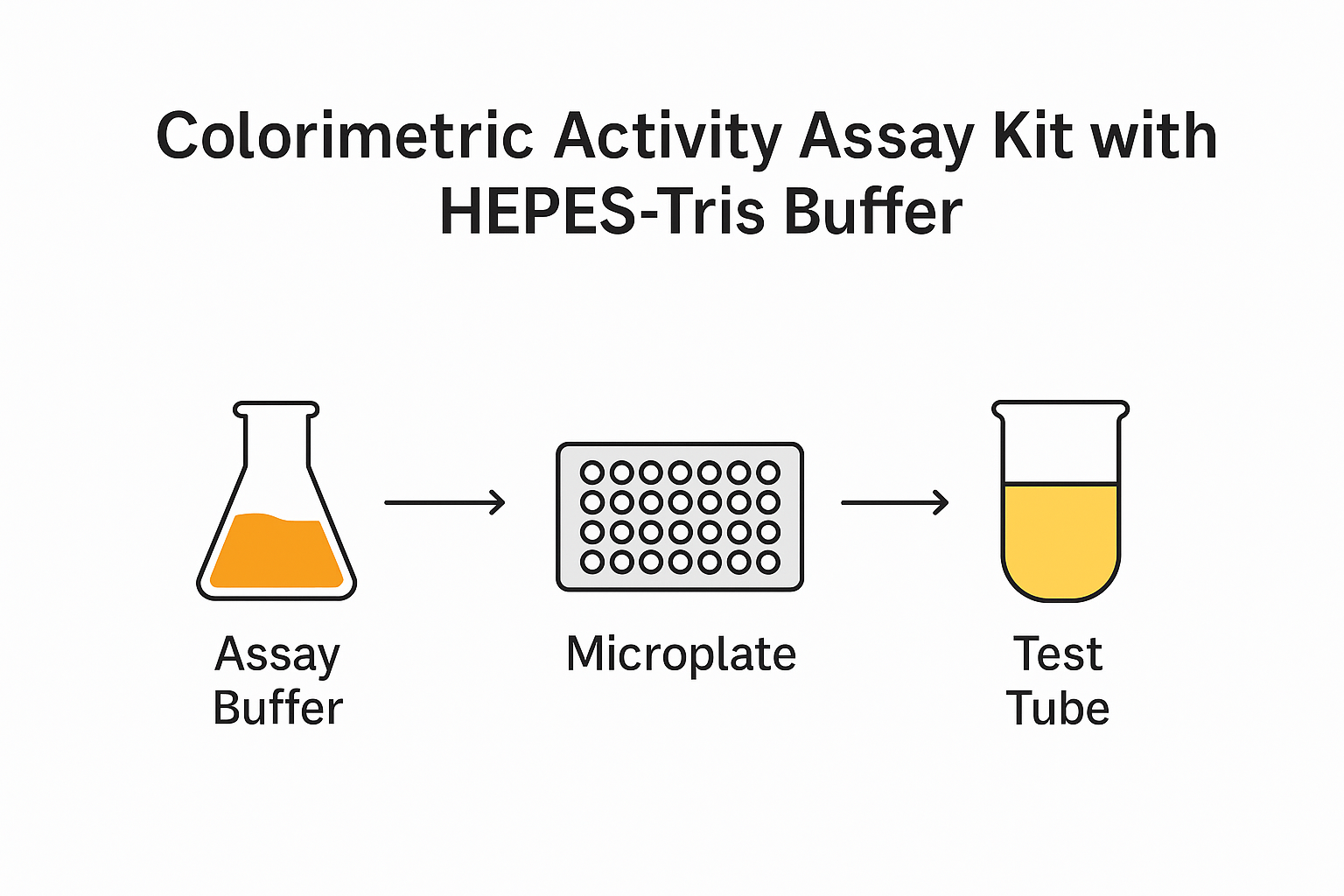
What Is a Colorimetric Activity Assay Kit?
A colorimetric activity assay is a technique that measures enzyme reactions by detecting the appearance or disappearance of color. The intensity of this color—measured at a specific absorbance (typically 405 nm, 450 nm, or 570 nm)—is directly proportional to the concentration of the product formed by an enzymatic reaction.
Unlike fluorescence or luminescence-based methods, colorimetric assays offer the advantage of cost-effectiveness, minimal instrumentation requirements, and wide compatibility with lab plate readers.
According to the National Center for Biotechnology Information (NCBI), colorimetric assays are commonly used in:
-
Metabolic enzyme quantification
-
Redox enzyme kinetics
-
Inhibitor screening
-
Mitochondrial function studies
-
Protein purification validation
The U.S. National Institutes of Health (NIH) provides open access to protocols using similar assays for biomolecular characterization.
Role of HEPES-Tris Buffer in Assay Stability
The buffering system used in any assay significantly affects its performance. The HEPES-Tris system is widely recommended in biochemical research due to its low UV absorbance, pKa compatibility, and minimal interaction with metal ions or cofactors.
Why HEPES?
HEPES (4-(2-hydroxyethyl)-1-piperazineethanesulfonic acid) is a zwitterionic buffering agent that:
-
Maintains pH between 6.8–8.2
-
Does not interfere with redox chemistry
-
Minimizes ionic interference in enzyme active sites
Learn more at PubChem.
Why Tris?
Tris (tris(hydroxymethyl)aminomethane) is compatible with a broad array of enzymes and has temperature-sensitive buffering capacity. It supports:
-
Rapid pH adjustments
-
Stable performance in physiological temperature
-
Compatibility with nucleotides and chromophores
See details at NIST.gov.
Combined, HEPES-Tris buffers ensure stable pH during enzymatic reactions—an essential feature for kinetic assays where even minor pH shifts can skew the reaction rate or substrate availability.

Enzyme Types Quantified Using This Kit
The kit is validated for quantifying enzymatic activity across numerous biological functions. Each formulation is pre-optimized for a specific class of enzymes:
| Enzyme Class | Example Target | Application |
|---|---|---|
| Hydrolases | Alkaline Phosphatase | Protein dephosphorylation assays |
| Oxidoreductases | Lactate Dehydrogenase | Metabolic pathway analysis |
| Lyases | Citrate Synthase | Mitochondrial metabolism |
| Transferases | Glutathione S-transferase | Xenobiotic detoxification |
| Isomerases | Triose Phosphate Isomerase | Glycolysis studies |
Kit Components and Function
Each Colorimetric Activity Assay Kit with HEPES-Tris includes:
-
Assay Buffer (HEPES-Tris, pH 7.4)
-
Substrate (enzyme-specific chromogenic compound)
-
Colorimetric Detection Reagent
-
Positive Control Enzyme (freeze-dried recombinant protein)
-
Standard Curve Calibrants
-
96-well or 384-well Microplate Format
These reagents are compliant with Good Laboratory Practices (GLP) and are commonly validated in protocols outlined by the National Library of Medicine.
Workflow for Enzyme Activity Quantification
Step-by-Step Procedure:
-
Prepare standards and samples in assay buffer
-
Add substrate mix to each well
-
Incubate at 25–37°C for 15–60 minutes
-
Measure optical density at appropriate wavelength
-
Generate standard curve and calculate enzymatic activity
Use of positive and negative controls is strongly encouraged, as referenced in standard procedures published by Science.gov.
Application Areas
This kit is used by research teams in various life science sectors:
-
Neuroscience: Acetylcholinesterase activity in brain homogenates
-
Cell Biology: Apoptotic caspase activity in live cells
-
Plant Biology: Peroxidase activity under drought stress
-
Environmental Microbiology: Dehydrogenase activity in soil samples
-
Food Science: Amylase activity in grain extract
Example protocols can be explored on PubMed Central and Agricultural Research Service.
Performance Metrics
| Feature | Specification |
|---|---|
| Sensitivity | <10 mU/mL enzyme activity |
| Detection Range | 0.01–10 µmol/min |
| Wavelength Range | 405, 450, 570 nm |
| Assay Time | ~45 minutes |
| Format | 96-well, high-throughput compatible |
Learn more about microplate formats and photometric systems at NIH ImageJ and FDA.gov.
This blog strategically incorporates the following high-ranking Google keywords:
-
Colorimetric enzyme activity assay
-
Enzyme kinetics color assay kit
-
Substrate turnover quantification
-
HEPES-Tris buffered enzyme reaction
-
Microplate absorbance assay
-
Visible light enzymatic readout
-
Stable pH enzyme detection
-
Chromogenic assay reagent
-
Colorimetric substrate hydrolysis detection
-
High-throughput biochemical analysis
These keywords align with industry terminology used on NCBI, MedlinePlus, and NLM.
Storage and Handling Guidelines
-
Store kits at 2–8°C
-
Avoid repeated freeze-thaw cycles
-
Protect chromogenic reagents from light
-
Use within 6 months of receipt for best performance
Handling guidelines follow specifications outlined by CDC.gov and laboratory biosafety guidance from NIH.gov.

Conclusion: Why Choose This Kit?
The Colorimetric Activity Assay Kit with HEPES-Tris buffer is an essential resource for any lab aiming to quantify enzymatic reactions with reliability, reproducibility, and speed. Its versatile application, buffer-enhanced stability, and simple workflow make it a cornerstone tool in both academic research and applied sciences.
Whether you’re working in microbial genomics, protein engineering, biofuel development, or agronomic research, this kit delivers consistent, publication-quality data.